
Last Updated: November 12, 2026
Quick Summary
The Delray Beach condo renovation HOA approval process requires a complete application, stamped plans, contractor licensing and insurance, and written board sign-off before demolition starts. Treat your condo renovation HOA submission as a gate, not a formality, and confirm submission deadlines and meeting cadence in writing.
- Written board approval is a legal precondition under Florida condominium governing documents, not a courtesy.
- Most associations require packets 10 to 15 business days before a board meeting.
- Contractor certificates should name the association as additional insured with current state licensing.
- Association approval does not replace a City of Delray Beach building permit and inspections.
- Resubmit the complete packet and respond to every board comment in writing.
Table of Contents
- Understanding the Delray Beach Condo Renovation HOA approval Process
- Why HOA and Condo Association Approval is Non-Negotiable
- The Delray Beach Condo Renovation HOA Approval Form and Document Packet
- Condo Renovation Plans and Drawings: What Your Board Expects
- Condo Renovation Contractor Insurance Requirements and Licensing
- City of Delray Beach Permits and Building Department Sign-Off
- The Condo Renovation Approval Timeline: From Submission to Start Date
- What to Do After a Denial, Conditional Approval, or Revision Request
- How a Luxury Design-Build Firm Simplifies Your HOA Approval
- Requesting Your Pre-Renovation Consultation
- Frequently Asked Questions
Understanding the Delray Beach Condo Renovation HOA approval Process
The Delray Beach condo renovation HOA approval process is a formal, document-driven review in which your condominium association and building management evaluate proposed interior work before construction begins. Approval typically requires a complete application, stamped plans, proof of contractor licensing and insurance, and written sign-off from the board before any demolition starts.
At Bluestone Contractors, we have learned that this sequence decides your entire schedule. Owners who treat the association as an afterthought lose weeks. Owners who submit a flawless packet on day one start on time. Below, we walk through the full approval path, from the first form to the final inspection, so you can plan a renovation that clears review without drama.
Why HOA and Condo Association Approval is Non-Negotiable
Written approval is a legal precondition, not a courtesy. In Florida, condominium governing documents give the board authority over alterations to units and common elements, and most declarations require prior written consent for interior changes that affect building systems or shared structures. The Florida statutes governing condominiums set the framework, while your own declaration and rules carry the specifics.
Skipping approval carries real consequences: stop-work orders, fines, forced restoration at your expense, and disputes that follow the unit when it sells. A common mistake is assuming that because the work is entirely inside your walls, the board has no say. In practice, plumbing, electrical, and structural changes almost always touch shared systems, which brings the association into the conversation early.
The Delray Beach Condo Renovation HOA Approval Form and Document Packet
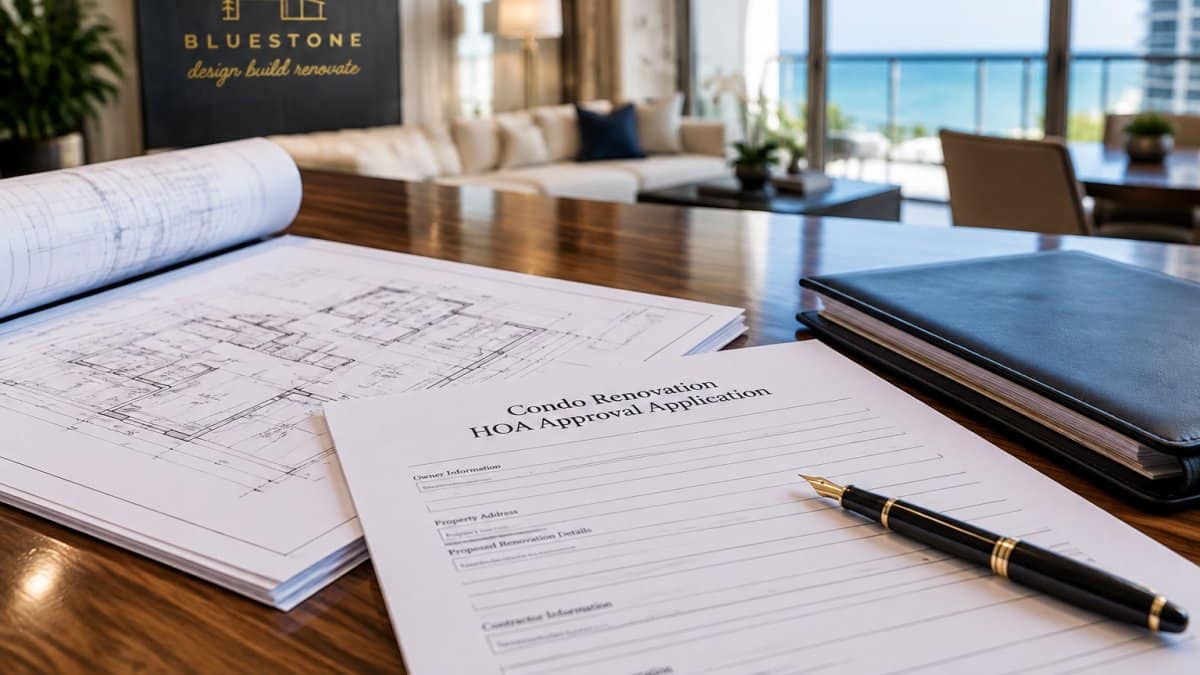
Most associations publish a standard alteration application, often called the Delray Beach condo renovation HOA approval form, and the packet behind it matters as much as the form itself. Expect to assemble:
- The completed alteration application signed by the registered owner
- A scope of work describing every change, material, and finish
- Plans and drawings prepared by a licensed architect or engineer
- Contractor license and certificate of insurance naming the association
- Product approvals and material specifications for flooring and finishes
- Any engineer letter required for structural changes
Associations differ on what they demand, so request the current checklist in writing before you design. A complete packet submitted once moves faster than a partial packet submitted three times.
Condo Renovation Plans and Drawings: What Your Board Expects
Boards review drawings for building safety, not for taste. Your condo renovation plans and drawings should clearly show what is being removed, what is being added, and how the work affects load-bearing walls, plumbing risers, and electrical service. Interior alterations that stop at finishes, such as flooring, paint, and cabinetry, usually require less scrutiny than structural changes.
What most owners miss is that boards want consistency. If your plans show a relocated fixture, your plumbing permit and your contractor’s scope must match. Discrepancies read as risk and invite revision requests. We recommend submitting one coordinated set of plans and drawings with a single scope of work that every other document references.
Condo Renovation Contractor Insurance Requirements and Licensing
Your contractor’s paperwork is where many applications stall. Condo renovation contractor insurance requirements typically include general liability coverage and workers’ compensation, with the association named as an additional insured, plus a current state license. Building management often sets minimum coverage limits and requests certificates directly from the carrier.
Verify licensing through the Florida Department of Business and Professional Regulation before you sign anything. Bluestone Contractors operates as a Florida Certified General Contractor, license CGC022980, and our commitment to professional integrity outlines our standards. A contractor who hesitates to provide certificates is a warning sign worth heeding.
City of Delray Beach Permits and Building Department Sign-Off
Association approval does not replace a building permit. Local building authorities generally require permits for structural changes, plumbing, electrical work, and many interior alterations, and inspections must occur at defined stages before work is covered. Your contractor should pull permits in the correct name and schedule inspections proactively.
Watch out: starting demolition while the permit application is pending can trigger a stop-work order and delay the project further. Sequence the work correctly, with association approval and city permits in hand before the first hammer swings. The City of Delray Beach building division publishes current submittal requirements and inspection stages.
The Condo Renovation Approval Timeline: From Submission to Start Date
A realistic condo renovation approval timeline runs several weeks to a few months, but the calendar is driven less by construction than by meeting cadence and document completeness. Associations meeting monthly can add weeks of waiting, and incomplete packets add revision cycles that extend the review window. Plan the sequence in this order, and build slack into every stage.
| Stage | Typical Duration | What Happens |
|---|---|---|
| Document packet assembly | 1-2 weeks | Forms, plans, insurance certificates, scope of work, product approvals |
| Association review | 2-6 weeks | Manager screening, board or architectural committee review, written questions |
| City permit review | 2-4 weeks | Submittal, plan review, permit issuance |
| Pre-construction logistics | 1-2 weeks | Elevator reservations, building notices, protection of common areas |
Typical Duration
Submission deadlines and board cadence. Most associations require packets a set number of days before a board meeting, commonly 10 to 15 business days, so a missed deadline pushes your review to the next month. Ask the manager in writing for the current submission deadline, the meeting schedule, and whether the board delegates alteration review to a manager or architectural committee. That single answer often determines whether your review takes two weeks or six.
Sequencing association review and city permitting. A common pattern is to run association review and city permit review in parallel once the packet is complete, but only if your association allows it. Some boards require written association approval before the contractor may submit for permits; others accept a copy of the permit application as part of the packet. Confirm the order before you file, because filing permits out of sequence can trigger a stop-work order.
Local workflow contacts. The approval path touches three separate authorities: your association’s manager or board, building management (which controls elevator access, work hours, and common-area protection), and the City of Delray Beach building division, which publishes current submittal requirements and inspection stages at City of Delray Beach building division. Keep a written log of every submission date, reviewer question, and response so you can prove the sequence if a dispute arises.
Watch out: starting demolition while the permit application is pending can trigger a stop-work order and reset your entire calendar, so treat association approval and city permits as gates, not formalities. A luxury renovation deserves a schedule that respects review cycles rather than one that assumes instant approval. Our process maps each phase so you know exactly where your project stands.
What to Do After a Denial, Conditional Approval, or Revision Request
A denial is rarely final; it is usually a request for better documentation. The first step is to classify the response. A revision request means the board wants specific items corrected and will re-review without a new application. A conditional approval means the work is approved subject to stated conditions, often an updated insurance certificate, a revised drawing, or a product approval, and the conditions must be satisfied in writing before work starts. A denial means the board rejected the application as submitted and typically requires a resubmission or an appeal under the association’s governing documents.
Address each point in writing. Read the board’s response line by line and respond to every item, even the ones you consider minor. A cover letter that quotes each board comment and states the corresponding change or clarification prevents a second round of questions. Where a comment is ambiguous, request written clarification from the manager rather than guessing, a short email asking the board to confirm its intent is faster than a resubmission that misses the point.
Know your appeal path. Most declarations and bylaws set out a process for reconsideration, and some provide a right to attend the next board meeting or to submit a written appeal. Ask the manager which path applies and what deadline governs it. If the denial rests on a document the board misread, a written clarification with the correct document attached often resolves it without a formal appeal.
Resubmission mechanics. Resubmit the complete packet, not just the changed pages, unless the manager confirms otherwise. Mark the resubmission clearly as a response to the board’s comments, reference the original application date, and keep proof of delivery. A common pattern is that resubmissions move faster than first submissions because the board already has the file.
Watch out: treating a conditional approval as a full approval and starting work before the conditions are satisfied in writing can produce a stop-work order even though the board ‘said yes.’ The pitfalls that lead to denials are predictable: incomplete scopes, mismatched plans, and contractors without proper certificates. A design-build team prevents most of them before submission. Our guide to avoiding remodeling pitfalls explains how early coordination keeps a project out of the revision loop.
How a Luxury Design-Build Firm Simplifies Your HOA Approval
A design-build firm consolidates design and construction under one team, which can reduce the gaps between architect, designer, and builder that lead to revision requests.
Bluestone Contractors brings a Florida Certified General Contractor-led team with a University of Florida-trained designer, so plans and construction documents are coordinated from the start. For condo owners, we handle HOA approvals, association requirements, building access, and high-rise construction as part of luxury condo remodeling in Boca Raton and Palm Beach County. Discerning clients get a single point of contact throughout the project.
Requesting Your Pre-Renovation Consultation
The strongest applications begin with a conversation, not a form. Bring your goals, your association’s documents, and your timeline to a pre-renovation consultation, and we will map the approval path before design begins.
At Bluestone Contractors, our integrated design-build approach, turnkey project management, and our integrated approach mean your condo renovation starts on solid footing. We coordinate the drawings and manage the process so you can focus on the finished space. Schedule a design consultation with Phyllis Michaels and begin with a clear plan.
Your association holds the keys to your start date, and a flawless submission is the fastest way to get them. Bluestone Contractors combines integrated design-build delivery, turnkey project management, and expert navigation of complex renovation requirements under one roof. Get started with Bluestone Contractors and move from approval to a beautifully finished condo.
Frequently Asked Questions
Do condo renovations need both association approval and building permits?
Yes, in almost all cases, you need both. The condo association approval is a private, contractual requirement governed by your building’s governing documents. A building permit is a public requirement from the City of Delray Beach to ensure work meets the Florida Building Code. Your project cannot legally start until you have written approval from your association and the necessary permits from the city.
Can an HOA control interior renovations in a condo?
Yes, an HOA can control interior renovations, especially those affecting the building’s structure or common elements. While you own your unit’s interior, your governing documents give the association authority over changes that could impact structural integrity, plumbing, electrical systems, or the building’s exterior appearance. This is why submitting detailed condo renovation plans and drawings is a standard part of the approval process.
How long does condo association approval for a renovation take?
The condo renovation approval timeline varies by association. Simpler projects can be approved faster than full-unit renovations with structural changes. Timelines depend on the board’s meeting schedule, the completeness of your application, and whether revisions are requested. A well-prepared submission is the best way to avoid delays.
What should a condo renovation HOA application include?
A complete application package typically includes the association’s specific approval form, a detailed scope of work, architectural plans and drawings, material specifications, and contractor documentation. The contractor packet should include proof of licensing, certificates of insurance meeting the association’s requirements, and a signed contract. Always check your building’s alteration policy for the exact list.
What happens if you remodel a condo without the required permit in Florida?
Remodeling without a required permit in Florida can lead to serious consequences, including fines, a stop-work order, and the requirement to remove or correct the unpermitted work at your own expense. It can also complicate future property sales and violate your condo association’s rules, potentially resulting in further penalties from the board.
What should you do if a condo renovation application is denied?
If your application is denied, first request the specific reason in writing. The board may have concerns about structural impact, contractor credentials, or incomplete plans. Work with your design-build team to revise the proposal and address the board’s points directly. You can then resubmit the application. In some cases, a meeting with the board or architectural review committee can clarify the path forward.